I spend much time on X and YouTube. I knew this the way you know you should drink more water—vaguely, guiltily, and without ever actually doing anything about it.
So I built an app.
Why I Didn’t Just Download One
I know screen time apps exist. Digital Wellbeing comes built into every Android phone. There’s StayFree, ActionDash, dozens of others.
I didn’t try them.
Not because I think they’re bad. But because I already knew what they’d offer: dashboards full of charts, app blockers, strict modes, timers that lock you out. Features on features on features.
Here’s my problem with that approach: my brain rebels against restrictions.
Tell me I can’t open X after 30 minutes, and suddenly that’s all I want to do. Set an alarm to warn me, and I’ll dismiss it without thinking. Block an app, and I’ll find workarounds. My mind doesn’t respond to force. It fights back.
I needed something different. Something that doesn’t fight me—just shows me.
The Psychology I Was Betting On
I believe in slow change. The kind that happens when you feed your brain small pieces of information, day after day, until one day it just… decides to shift.
No dramatic intervention. No willpower battle. Just quiet, consistent awareness.
So I asked myself: where do I already look, constantly, without thinking?
The notification bar.
Every time I swipe down to check a message, every time I glance at my phone—that’s where my eyes go first. It’s automatic.
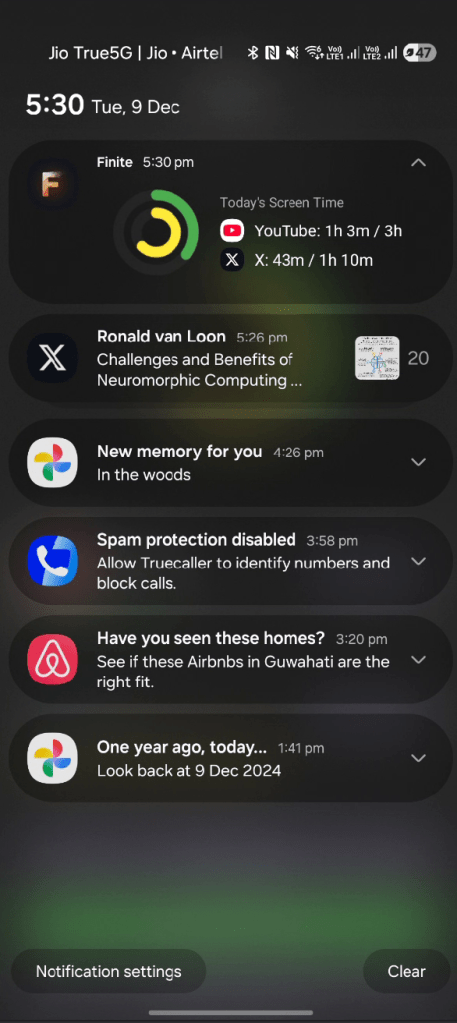
What if my screen time was just… there? Not buried in settings. Not behind three taps. Just visible. Always.
What I Built
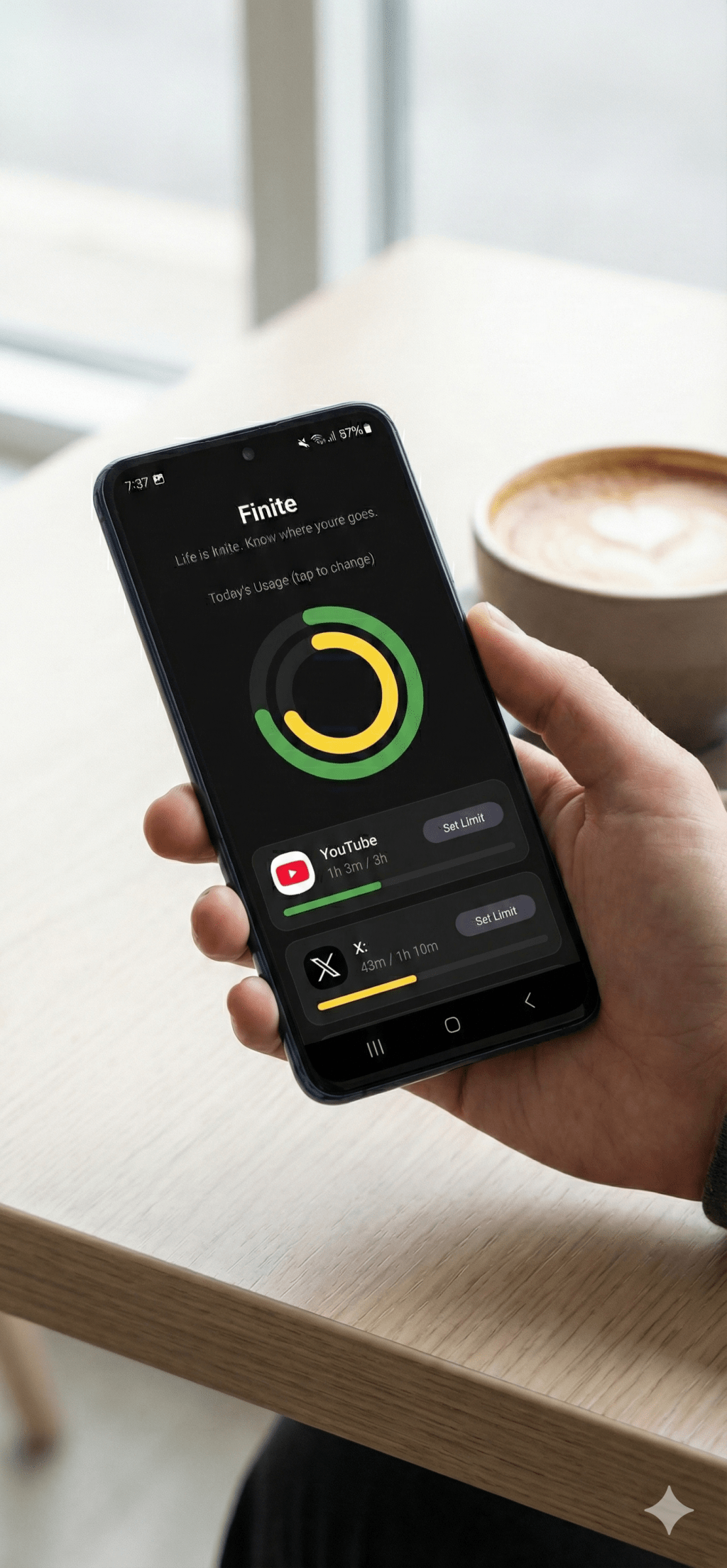
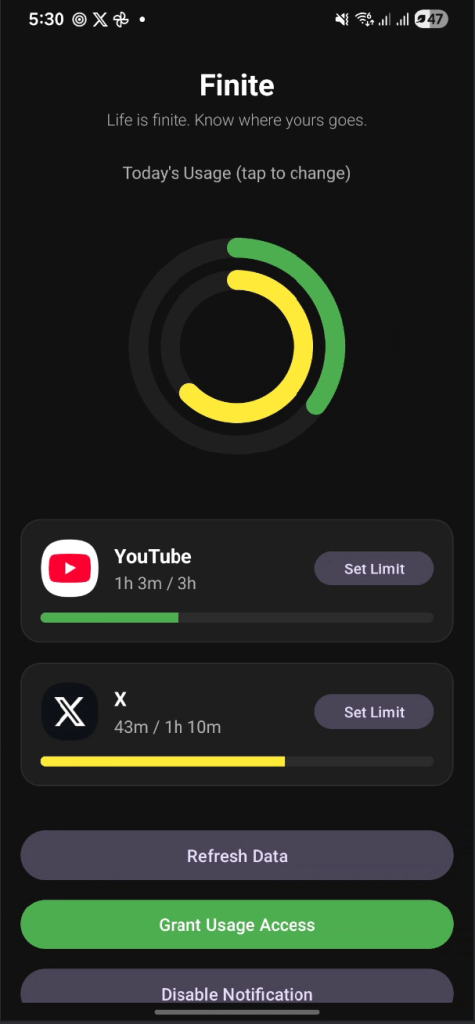
I spent half a day building a small app called Finite. It shows my top 2 apps as colored rings in my notification bar. Green means I’m fine. Yellow means moderate. Red means maybe put the phone down.
That’s it. No blocking. No alarms. No strict mode.
Just a quiet presence. Every single time I touch my phone, it’s there. “X: 1h 47m.” Can’t unsee it.
Some days the data is uncomfortable. I see red and think, “Really? That much?” Other days it’s genuinely satisfying—time spent on notes, reading, things that actually matter.
Both reactions are useful. The uncomfortable days plant a seed. The good days reinforce that my phone can be a tool, not just a time sink.
I’m not trying to defeat my phone. I’m trying to direct it.
Then Something Unexpected Happened
I went on holiday.
When I checked my stats, X and YouTube had almost disappeared. My top apps were Chrome and Google Keep. I’d been researching ideas, jotting down notes, brainstorming.
I didn’t plan this. I didn’t notice it happening. The data just showed me.
The Part I Got Wrong
I spent years thinking X and YouTube were my problem.
They’re not. Not exactly.
The pattern was about context, not apps.
During work weeks, my brain is fried by evening. It reaches for easy, infinite content—mental junk food that requires zero effort.
On holiday? My brain had energy. It didn’t want junk. It actually wanted to think and create.
Same phone. Same apps. Completely different behavior.
The tool I built to fix a problem showed me I’d misunderstood the problem entirely.
Why This Matters
Most solutions fight you. They assume you need to be controlled, restricted, locked out of your own device.
But I think the phone is one of the most powerful tools we have. It can make life genuinely better—if we learn to direct its energy instead of letting it direct ours.
That doesn’t happen through force. It happens through awareness. Small, daily reminders that let your mind process, justify, and eventually—on its own timeline—decide to change.
I didn’t need an app to block me. I needed an app to show me.
Half a day to build. One week to learn something I’d missed for years.
Life is finite. Know where yours goes.
 Soumya's World
Leave a comment